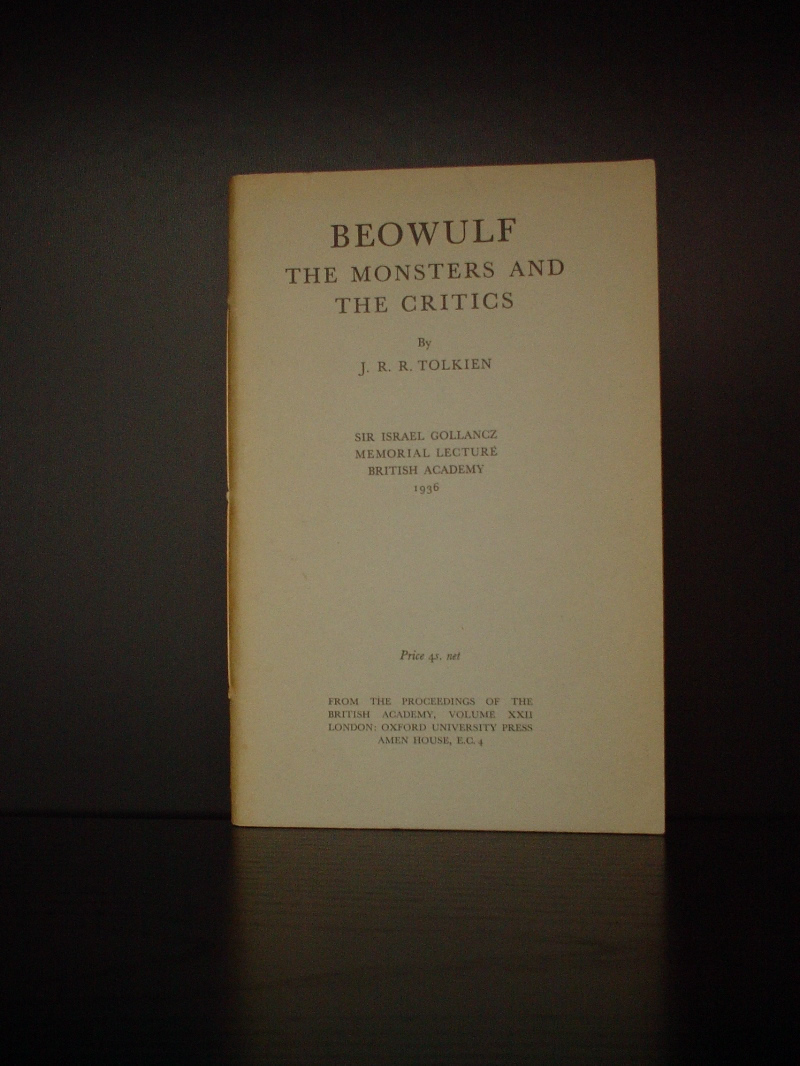
Tolkien was the first critic to draw attention to the poem as a poem
and to point out that the central literary structure of the tale revolves
around the hero's battles with them monsters, which previous critics had
dismissed as mere fabulous emendations to a tale whose primary value was
historical.
Editions:
Originally published by Oxford University Press in 1937 (2nd ed. 1958,
3rd ed. 1969) and by Folcort Press in 1969, Norwood Editions in 1975,
R.West in 1977 and Arden Library in 1978.
The essay is included in a lot of books, f.e. in The
Monsters and the Critics and Other Essays.
Review:
On June 27, 1925 Tolkien submitted a letter to the University of Oxford applying for the Professorship of Anglo-Saxon Studies, (Letters, p. 12-13) in which he outlined his "enthusiasm for Anglo-Saxon studies...[as] naturally attractive" to him. At age 33, he received the appointment. Tolkien later referred to the Essay as "the contact of the heroic with the fairy-story." (Letters, p. 350), as well as his love of linguistics and his work on the OED.
Tolkien argues that myths are, "Stories told about man’s relationship with nature; localized in time and place." - the Essay on Fairy Tales. "The Monsters and the Critics" was a lecture given in 1936 to the British Academy. This lecture caused a total shift of focus in the way scholars viewed the Old English poem, Beowulf.
In the post-New Age world, it's hard to grasp what Tolkien was refuting. Today, the prevailing wisdom is that folklore and mythology are the keys to spiritual enlightenment. They are handy watering places for us as we follow our Road To Bliss. Tales of magic, monsters and the like nourish us, for they clue us in to bits of reality that we cannot grasp through the scientific method.
In Tolkien's day, however, scholars held that mythology was the product of a primitive mentality. Poems such as Beowulf were considered useful mainly as sources of old English vocabulary words and could hardly be considered great art. Moreover, they felt that there was something childish about mythology. The Beowulf poet, they said, had lowered himself by focusing on Beowulf's struggle with Grendel, Grendel's Mom and the Dragon when he could have been detailing the human interactions of Beowulf's tribe, the Geats, or perhaps giving an account of their military and diplomatic history. The consensus was that the poem was irrevocably marred because the Beowulf poet's brilliant language did not fit his low theme. Also, the important elements of the poem (wars, divided loyalties, and grand passions) were unaccountably kept at the periphery of the narrative, while the "trivial" stuff was placed at its heart. The focus on the monsters, they said, was "an inexplicable blunder of taste."
Tolkien, however, argues that in his encounters with these creatures from Hell, Beowulf confronts evil in its most pure form. He writes, "It is not an irritating accident that the tone of the poem is so high and its theme is so low. It is the theme in its deadly seriousness that begets the dignity of tone."
Even in these essays, the storyteller is at work. Tolkien keeps moving from academic, critical language into allegory, painting pictures with words. In arguing that Beowulf was not merely a historical document to be mined for Old English words and customs, he invents the story of a man who inherits a field filled with ancient stones. The man builds a tower. Later, critics come and knock down the tower so that they can analyze ancient inscriptions on the stones. They criticize the man for building the tower and remain completely unaware that "from the top of that tower the man had been able to look out upon the sea."
Now I remain convinced that those poor sods who read Beowulf: The Monsters and the Critics do so largely because they have fallen in love with the writer after reading The Hobbit and The Lord of The Rings - which means they'd read anything he wrote. Bad mistake. Really bad mistake. Tolkien's nonfiction requires a different approach. Not that these essays aren't worth reading, as Tolkien's a master storyteller in any form. I fondly remember finding a copy of his Tree and Leaf collection of essays which has one essay in it, 'On Fairy-Stories', followed by the story 'Leaf By Niggle', both of which are excellent. But for most mortals, The Hobbit and The Lord of The Rings are quite enough to know of the good don and his writings.
"The Monsters and the Critics" is not written for a general audience. It was written for scholars who had, among other things, a knowledge of the Old English and Latin languages and a familiarity with Beowulf and the critical analyses it has spawned. Tolkien's language in this essay is rich and allusive. It's not a text that one can breeze through.
Related pages:
Pages: 1 2 3 4 5 6
Estimated Total Results: 59
#1 Beowulf The Monsters and the Critics by JRR Tolkien 1936 1st ...
A wonderful first published edition of the lecture given by Prof Tolkien in November 1936, he lectures on the poem Beowulf, specifically the monsters ...![]()
#2 Results for: Beowulf+Monsters+Critics
Tolkien Library is the best source for Tolkien book collectors. It has a descriptive and illustrated bibliography. You can find all on Tolkien books, ...
#3 Results for: Beowulf+Monsters+Critics
Tolkien Library is the best source for Tolkien book collectors. It has a descriptive and illustrated bibliography. You can find all on Tolkien books, ...
#4 Results for: Beowulf+Monsters+Critics
Tolkien Library is the best source for Tolkien book collectors. It has a descriptive and illustrated bibliography. You can find all on Tolkien books, ...
#5 Tolkien Bibliography: books written by Tolkien in the Tolkien ...
#1 Beowulf The Monsters and the Critics by JRR Tolkien 1936 1st ... A wonderful first published edition of the lecture given by Prof Tolkien in November ...
#6 Results for: Beowulf+Monsters+Critics
Tolkien Library is the best source for Tolkien book collectors. It has a descriptive and illustrated bibliography. You can find all on Tolkien books, ...
#7 Results for: Beowulf+Monsters+Critics
Tolkien Library is the best source for Tolkien book collectors. It has a descriptive and illustrated bibliography. You can find all on Tolkien books, ...
#8 Tolkien Bibliography: books written by Tolkien in the Tolkien ...
Beowulf: The Monsters and the Critics can be called the most important article on Beowulf of the 20th century. Incredible as it may now seem, ...
#9 Tolkien Bibliography: books written by Tolkien in the Tolkien ...
A middle English Vocabulary · Beowulf: The Monsters and The Critics· The Hobbit · Farmer Giles of Ham · The Lord of the Rings · The Adventures of Tom ...
#10 Tolkien's Shorter Works and other interesting books by Walking ...
... in his famous 1936 lecture Beowulf: the monsters and the critics. ... Like Beowulf, Tolkien’s work has also failed to be properly appreciated and ...